Are liberals more intellectual than conservatives? And what does this have to do with personality science?
Are liberals more intellectual than conservatives? It is easy to imagine intellectual curiosity going together with a willingness to question tradition. Yet conservative philosophers and traditionalist theologians are hardly strangers to abstract ideas. Perhaps a simple comparison between two extreme groups misses something about the relationship, and we need a more complete picture.
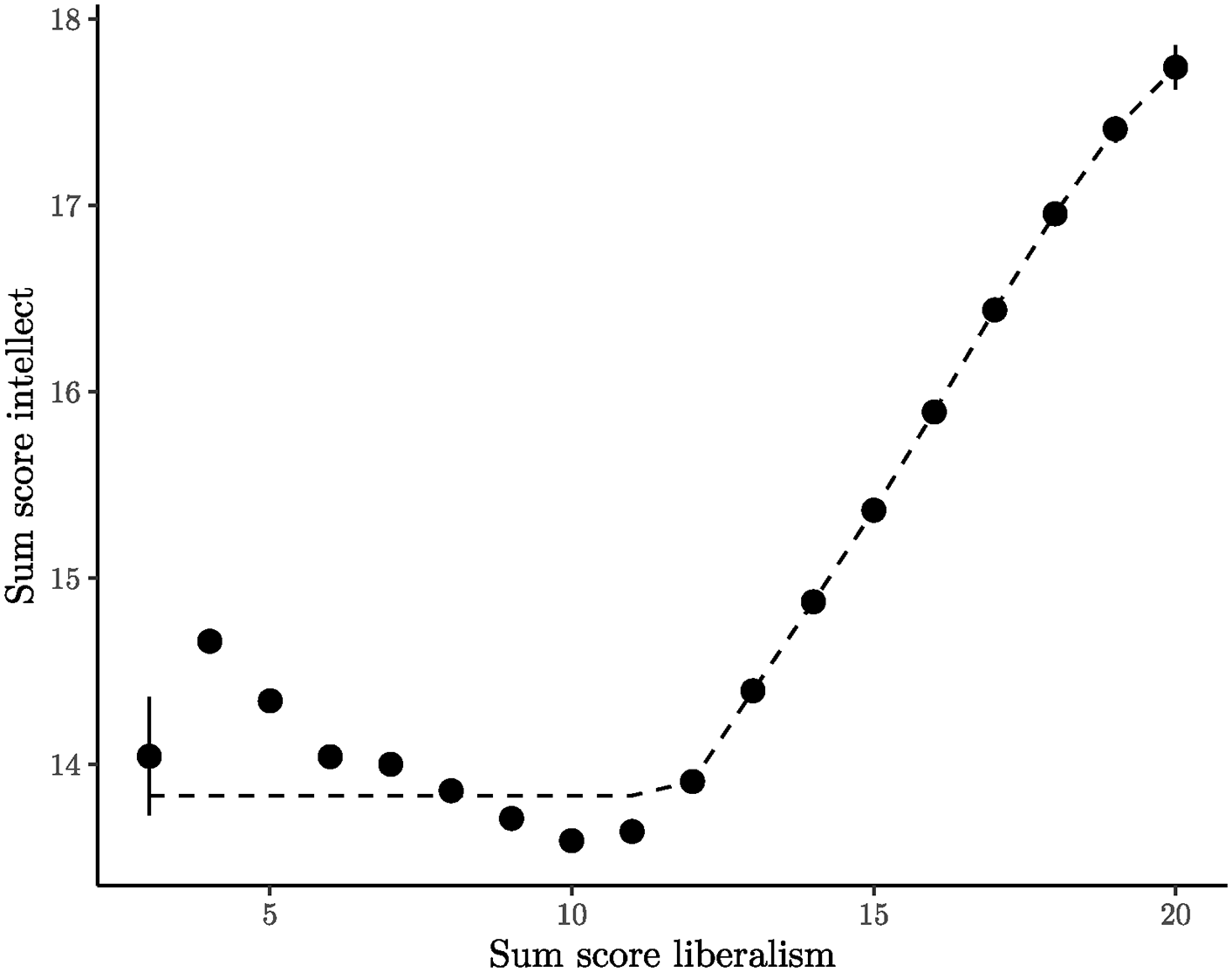
Figure 1 plots average intellect scores against liberalism scores in a large dataset of IPIP-NEO-120 personality questionnaire responses (Johnson, 2014). Indeed, the pattern is more complex and roughly U-shaped: intellect rises strongly toward the liberal end, but also rises over part of the conservative range. But why is this interesting and relevant for personality science?
Why personality science should care
In widely used Big Five inventories, liberalism and intellect belong to the same broad domain: openness to experience (Johnson, 2014). Their scores contribute to an aggregate openness score. If that score is interpreted as measuring one ordered trait, the contributing facets should be compatible with a common ordering. The reversal of the slope in Figure 1 challenges precisely that interpretation.
But why? The formal argument is a bit too complex for a short blog post, so check out the paper itself for the details. The intuition is straightforward: if intellect and liberalism can be reduced to a single latent dimension, an increase along that dimension should consistently be accompanied by an increase in both intellect and liberalism. This constrains the relationship between intellect and liberalism to be monotonic: it can curve, but it cannot reverse direction. This is one of the central ideas behind state-trace analysis (Dunn & Kalish, 2018).
Note that this idea is quite different from asking whether two measures correlate. A positive correlation can summarize the overall trend while hiding a slope reversal. Conversely, a curved but monotonic relationship can be compatible with one dimension. State-trace analysis tests monotonicity directly, making it more informative for this question than studying correlations, for example through factor analysis.
The PLOS analysis used existing self-report data. In a new paper with Benedikt Gailer (Titz & Gailer, 2026), now published in the Journal of Research in Personality, we asked a complementary experimental question: can controlled changes in information about a person produce a similar nonmonotonic pattern in judgments of liberalism and intellect?
An experiment lets us vary the information observers receive and test the causal effects of that information on their judgments. That gives us control over the cues behind the pattern and a test of whether one dimension can explain the resulting personality perceptions.
The experiment
Participants read short vignettes describing a fictitious person’s questionnaire responses. We varied two kinds of information:
- Self-efficacy: low or high, indicated by statements about handling tasks and getting things done.
- Artistic interest: low, medium, or high, indicated by statements about art, beauty, and poetry.
Combining these two factors produced six conditions. For a detailed explanation of why we chose these particular variables, check out the paper.
Participants then judged each target’s liberalism and intellect using items from the IPIP-NEO-120 (Johnson, 2014).
Each participant encountered the six conditions in an independently randomized order. We analyzed both the first vignette each participant saw, giving a between-subjects comparison without carry-over from earlier vignettes, and the complete sequence, giving a within-subjects comparison. The sample included 113 participants; one was excluded from the within-subjects analysis for not following instructions.
Violation of unidimensionality
At each level of artistic interest, targets described as having low self-efficacy were judged more liberal but less intellectual than targets described as having high self-efficacy. Figure 2 shows the resulting pattern across all six conditions, which could not be accommodated well by a single monotonic ordering.
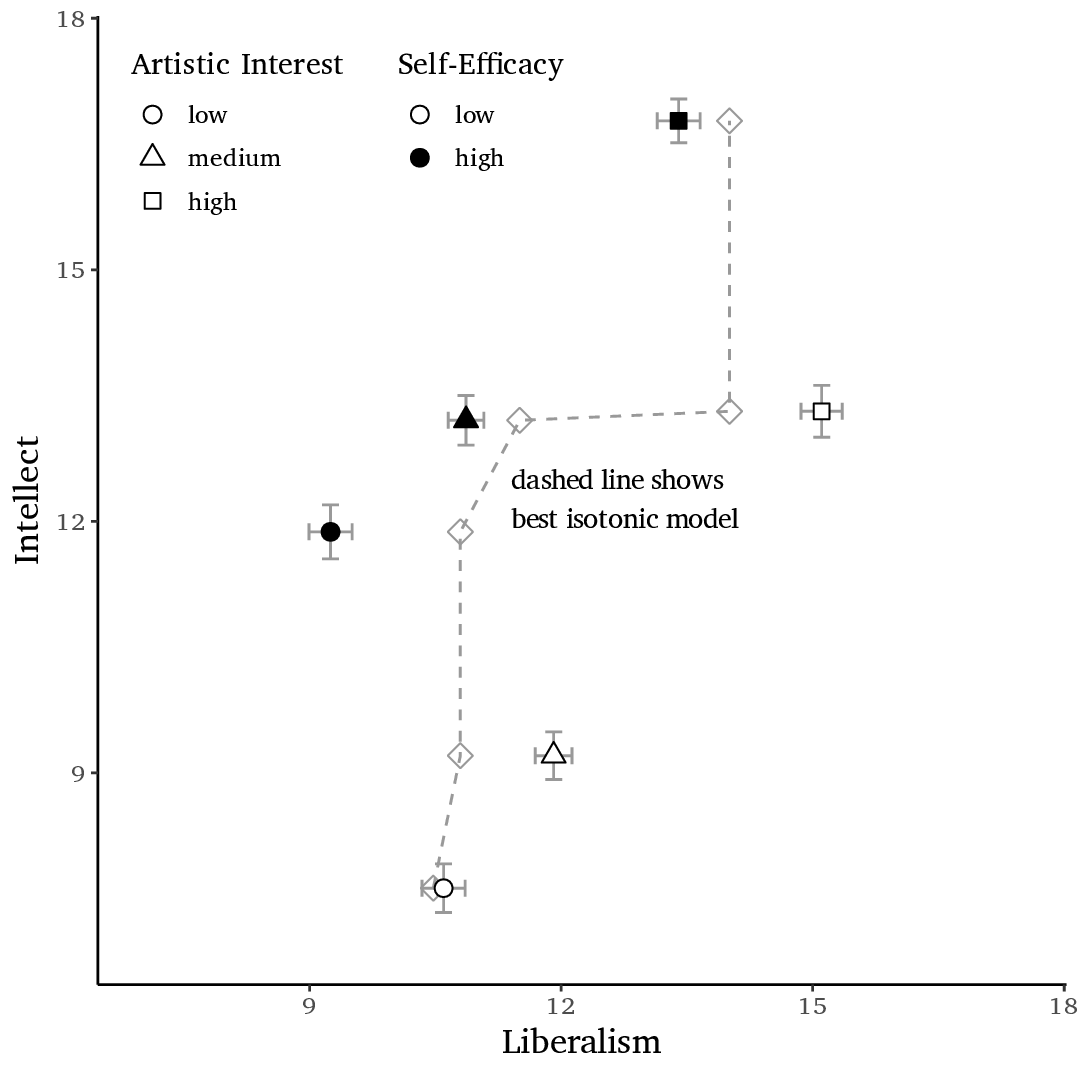
The best-fitting monotonic model was rejected in both analyses: approximately \(p = .0143\) for the between-subjects comparison and \(p < .00001\) for the within-subjects comparison. Both met the adjusted significance threshold of .025.
Under the typical assumptions of state-trace analysis, at least two dimensions are required to explain these liberalism and intellect judgments.
What this means for the Big Five
Perceived liberalism and intellect cannot be placed on a single openness continuum in our experiment. This finding clearly challenges the interpretation of openness to experience as a coherent dimension within the Big Five. If openness requires at least two dimensions, then the Big Five probably involve at least six dimensions, and likely more.
One criticism, also raised by a reviewer, is that the Big Five model does not claim that there are only five dimensions because each domain has several facets. But by that reasoning, neuroticism and conscientiousness, for instance, would also be multidimensional. In fact, the large IPIP-NEO analysis (Titz, 2025) did not support that conclusion. For neuroticism and conscientiousness, the violations of unidimensionality were each attributable to a single problematic item. After setting aside the problematic item in each domain, the remaining items across all six facets were compatible with one dimension (Titz, 2025). Having several named facets therefore does not automatically imply that several latent dimensions are needed. Openness does seem special in this respect: it cannot be reduced to a single dimension, whereas the other Big Five domains probably can, with some careful modifications (Titz, 2025).
Limitations
The experiment concerns judgments of fictitious targets based on supplied information. It provides evidence about personality perception and implicit personality theories. Generalization to the trait structure of real people requires additional evidence.
The study was conducted in German, with a predominantly young, female, highly educated sample, many of whom studied psychology. The cultural context and familiarity with personality models may influence the judgments. The measures also follow the IPIP-NEO-120 questionnaire’s particular conception of openness (Johnson, 2014).
A broad openness score may also still be useful for prediction as a composite of different characteristics. But that usefulness does not establish that it measures one ordered latent trait.
Paper, data, and materials
- Published article: Titz, J., & Gailer, B. Q. (2026). Perceived liberalism and intellect cannot be reduced to a single openness dimension: A state-trace experiment. Journal of Research in Personality, 125, 104770. 10.1016/j.jrp.2026.104770.
- Full text: Download the published PDF (open access, CC BY 4.0).
- Archived data, materials, analysis code, and supplementary materials: Zenodo release 1.0.0.
- Analysis repository: github.com/johannes-titz/sta-openness.